Grande Arche: The Danish-Designed Landmark at the Edge of Paris
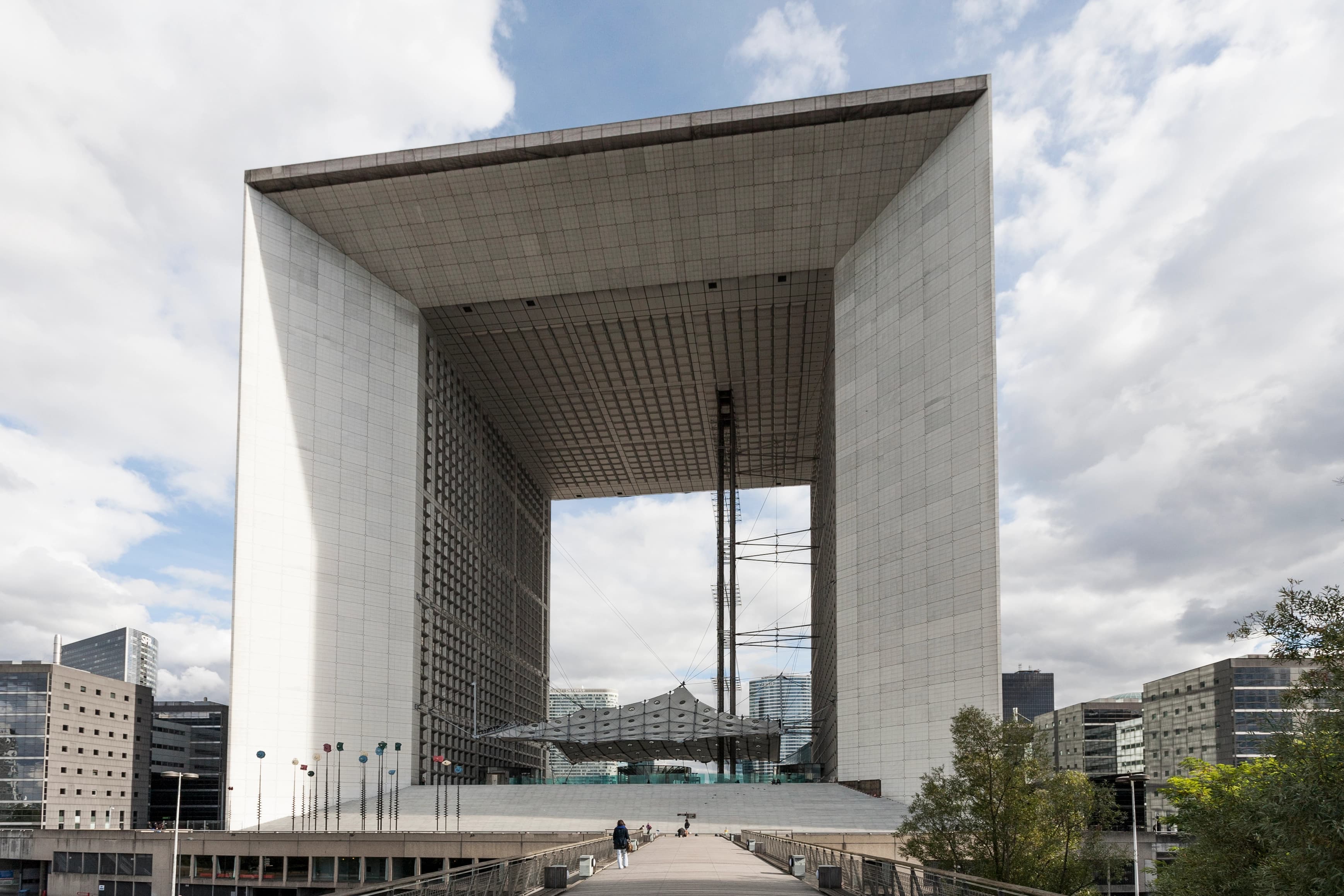
A radical megastructure and a surprising Danish imprint on the Paris skyline. Grande Arche is a presidential prestige project and the culmination of a historic axis through the city of cities – an open cube dedicated to humanity.
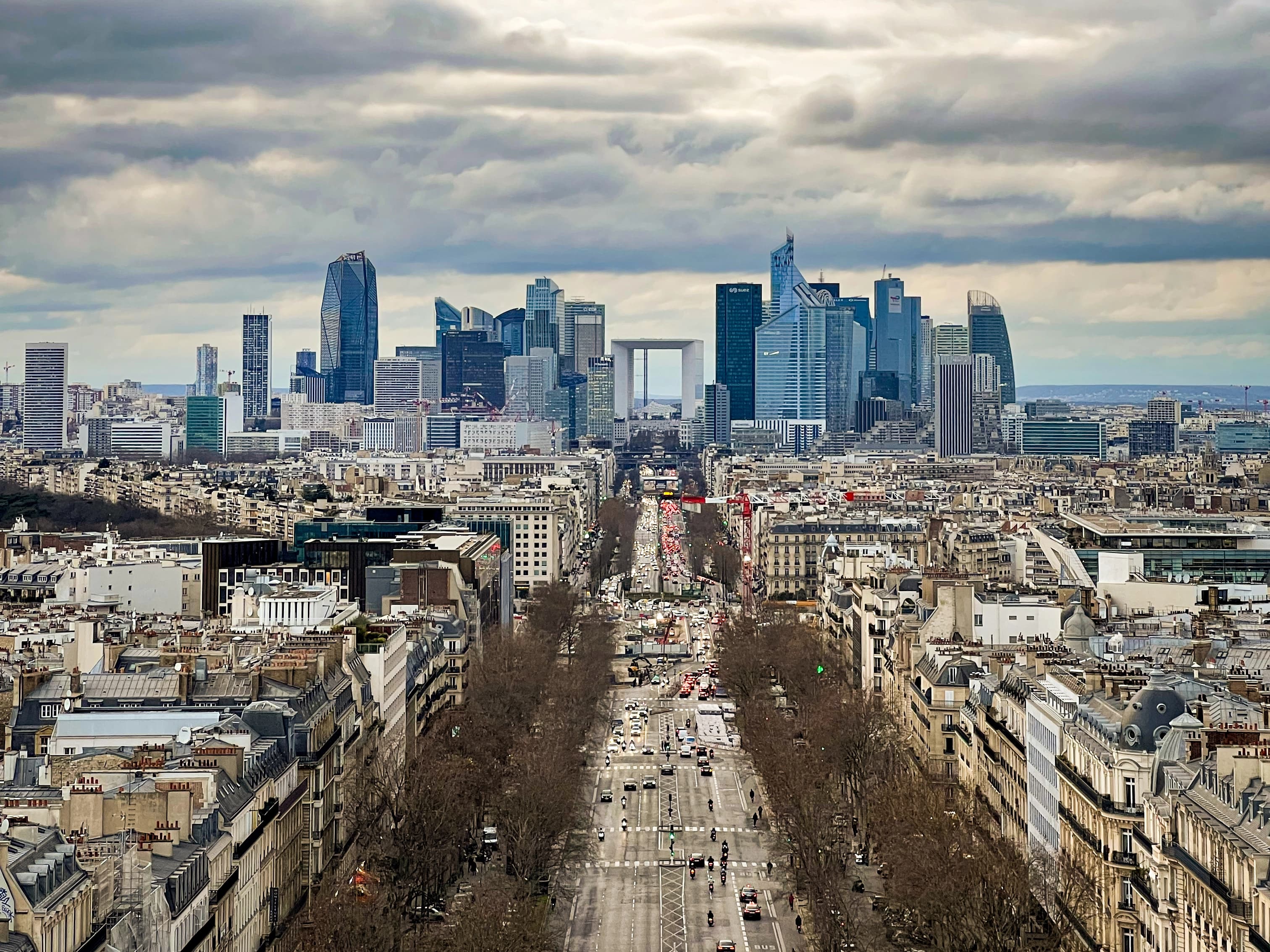
In the early 1980s, French president François Mitterrand set out to mark the 200th anniversary of the French Revolution with a series of major building projects – the Louvre Pyramid, the Bastille Opera, the new national library and a modern triumphal arch in the western business district of La Défense.
Where the classical Arc de Triomphe celebrates the army, Grande Arche was intended as a monument to humanism and international ideals – and at the same time an office building for ministries and international organizations.
424 proposals and one cube
In 1982, the French state launched an international competition for a “communications center” and monument at the end of the historic axis stretching from the Louvre across Concorde, along the Champs-Élysées and beneath the classical Arc de Triomphe. A total of 424 proposals arrived from around the world.
In 1983, a unanimous jury selected a proposal by a relatively unknown Danish professor: architect Johan Otto von Spreckelsen together with structural engineer Erik Reitzel. Their project – a gigantic open cube – not only broke the competition’s modest height limits, but it also insisted on a striking simplicity: an abstract frame for sky and city, as much window as building.
Within Mitterrand’s catalog of monuments, it was designated the modern, humanist counterpart to the Arc de Triomphe. Construction began in 1985, and Grande Arche was inaugurated on July 14, 1989 – the 200th anniversary of the storming of the Bastille.
From Danish churches to a global arch
From a Danish perspective, it seems almost unreal. The man who left his mark on Paris’ historic main axis had never done anything close to that scale before. Spreckelsen was indeed a professor at the Royal Danish Academy’s School of Architecture, but beyond his own home he had designed only four churches in Denmark.
In those churches you can see his use of simple geometries – especially squares – shaped into calm, light-filled spaces. Grande Arche can be read as an evolution of that logic: a cube unfolded into a frame where the void in between becomes the main event. As a foreign winner, he was paired – per French regulations – with architect Paul Andreu. The collaboration, though, was marked by political and economic pressures. Changing governments demanded savings, and materials, details and fees were all put on the table.
In 1986, Spreckelsen officially withdrew from the project; Andreu brought it to completion, while Reitzel continued as engineer until the inauguration. Spreckelsen never saw the arch completed – he died in 1987.
The open cube – geometry and rotation
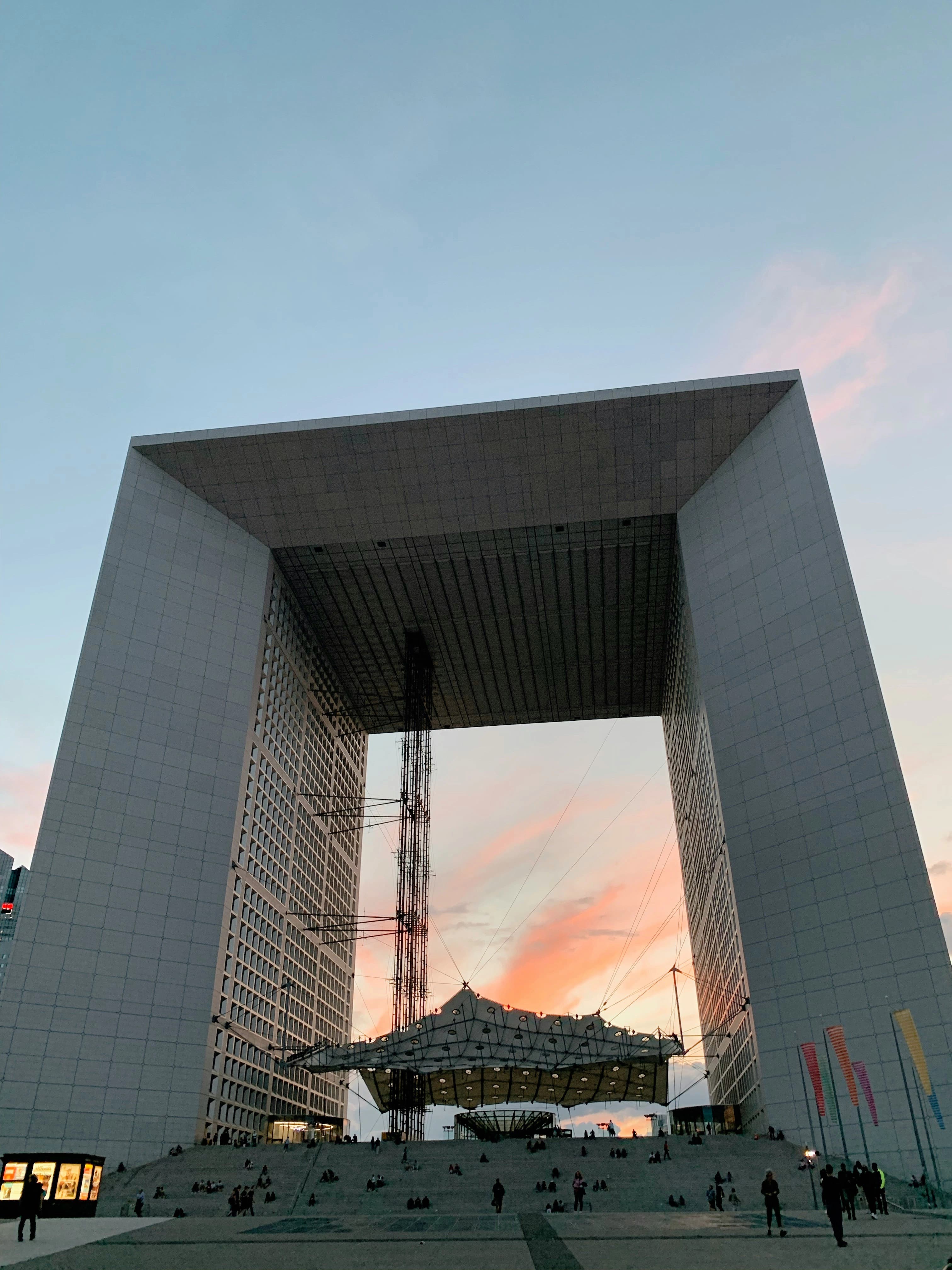
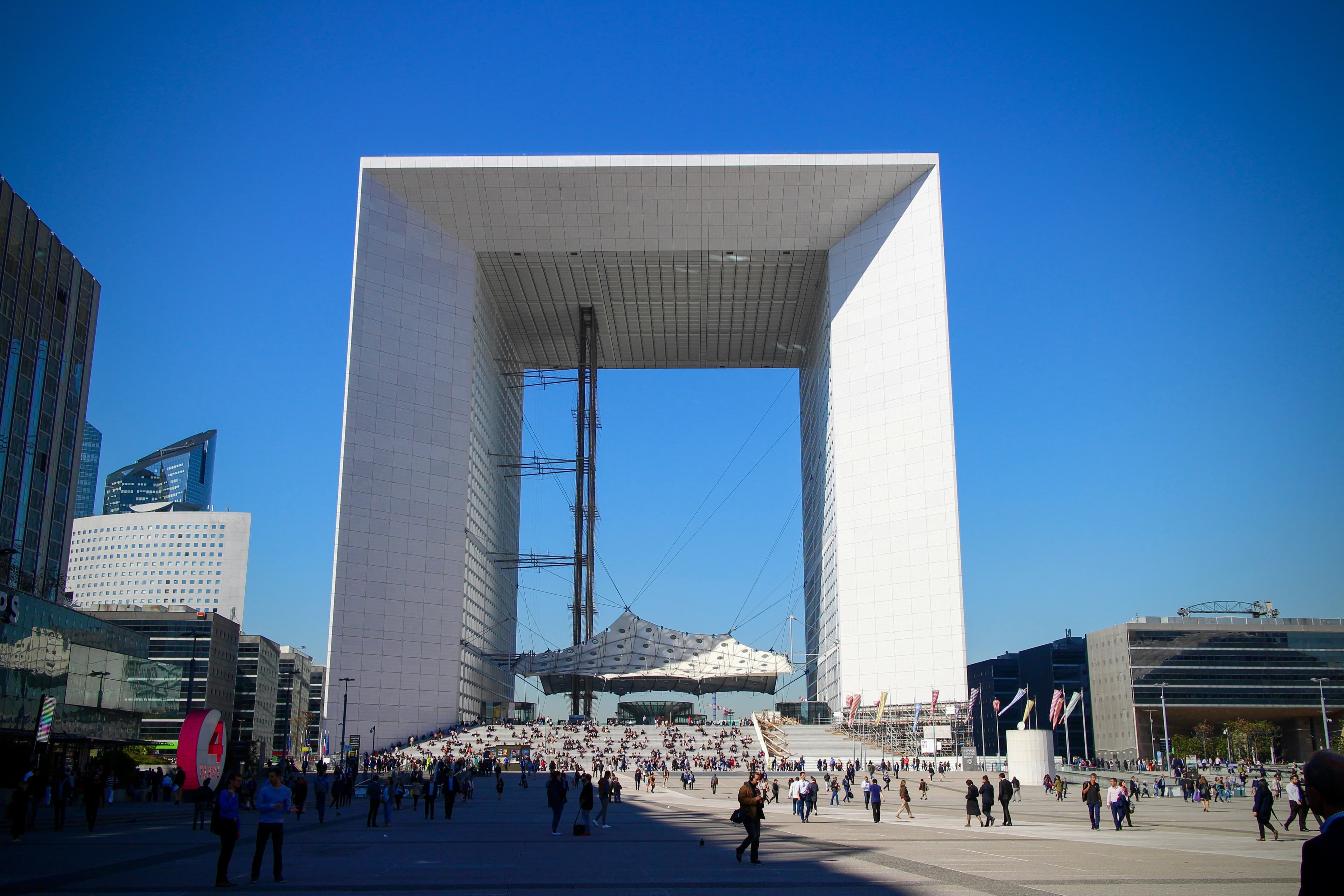
Grande Arche is almost a perfect cube: roughly 110 meters tall, 108 meters wide and 112 meters deep. It is as if the small Arc de Triomphe du Carrousel at the Louvre and the larger Arc de Triomphe at Étoile were scaled up once more – into a triumphal arch in skyscraper dimensions.
The most radical feature, however, is the void at its center. The space is so large that Notre-Dame could theoretically fit inside it – an almost unimaginable volume that only truly hits you when you stand on the plaza and look upward. The cube is rotated about 6.3 degrees from the straight axis running from the Louvre to La Défense. This was primarily due to a technical requirement: beneath the plaza lie a highway, metro lines and a train station, and the twelve colossal foundations had to be placed between existing tunnels. But the rotation has also been interpreted as intentional: it emphasizes the cube’s depth and simultaneously turns the building toward the Eiffel Tower and Tour Montparnasse – then the tallest skyscraper in Paris.
From Italian marble to American granite
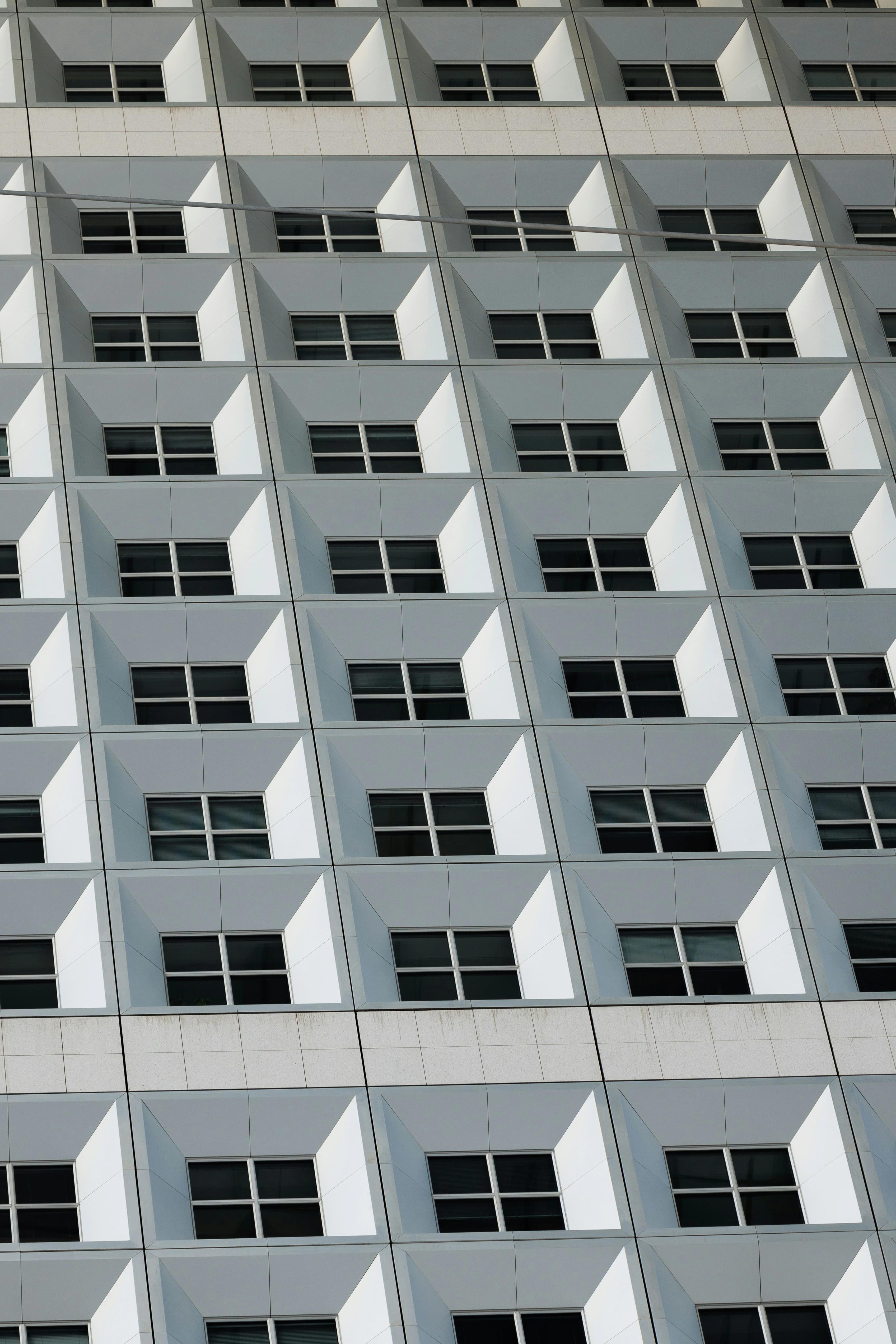
When Spreckelsen selected materials, he insisted on an almost dazzling whiteness. In addition to glass and granite, the facade was to be clad in Carrara marble – a stone used since ancient Rome and the same marble Michelangelo used for his David.
Spreckelsen traveled to Italy to find a particularly fine, white quality of marble, but it was expensive, and without his knowledge his French collaborator Paul Andreu accepted a cheaper variant.
Marble – costly or not – turned out to be problematic in Paris’ climate. It is porous, and water seeped in, froze and caused panels to bulge, crack and in some cases loosen. To prevent pieces from falling, parts of the facade had to be dismantled, and for a time the arch was closed to the public. In the 2010s, a major renovation replaced all marble with Bethel granite from Vermont. The granite restores some of the original lightness but is far more resilient to Parisian weather.
Open arch and closed roof
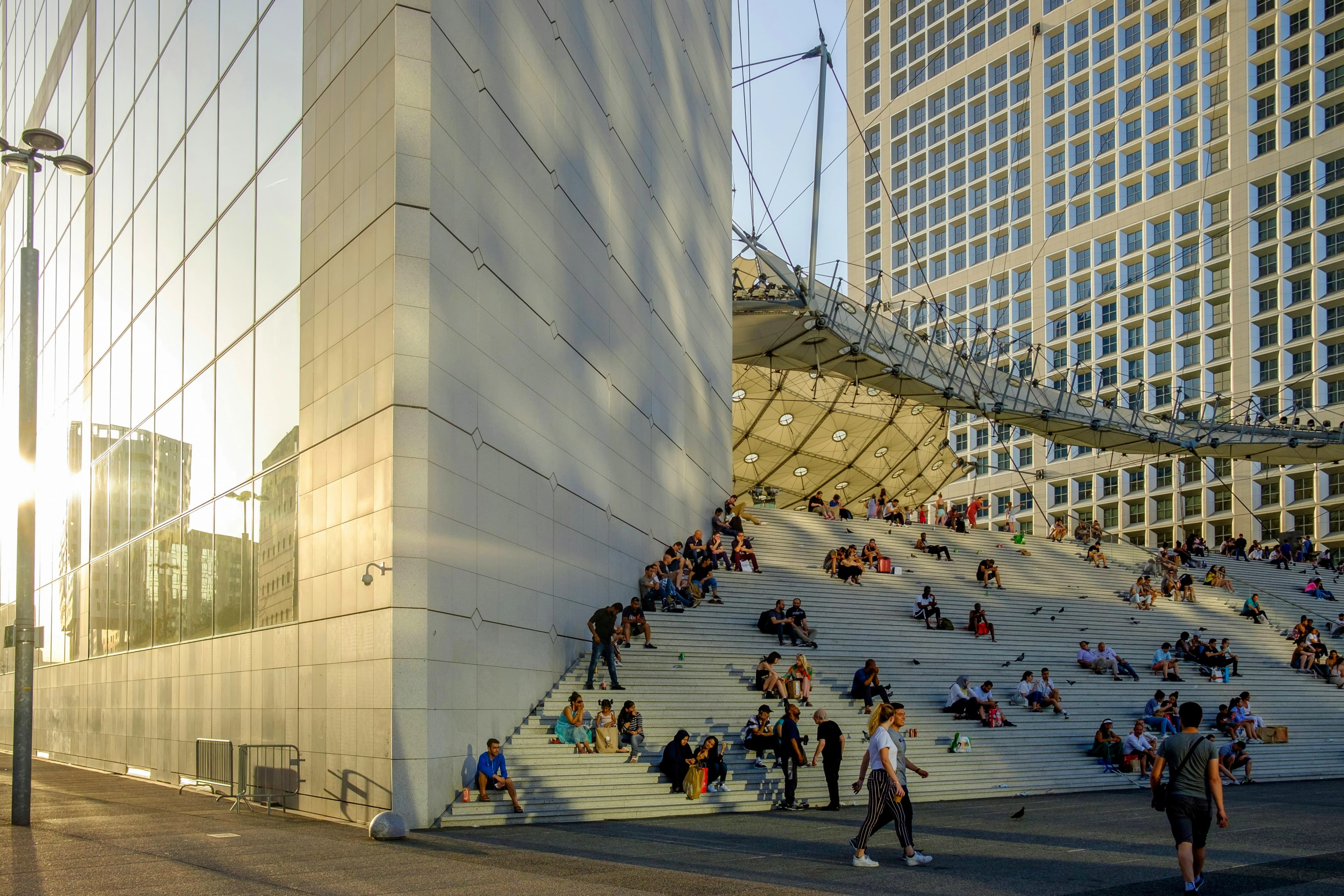
The “legs” of the arch are office buildings that house primarily government institutions, ministries and various technical authorities. On the plaza beneath and in front of the arch, the wide staircase functions as an informal amphitheater where office workers, students and tourists turn their backs on the traffic flows and look toward the city. For many years, the roof was also a spectacular part of the visit, offering an observation deck, exhibitions and a restaurant with a 360-degree panorama of Paris.
In April 2023, however, the roof was permanently closed due to high operating costs.
Grande Arche on film
The story of the Danish professor who won Paris’ grand competition – and later left his life’s work – has found new life. In 2025, the film L’Inconnu de la Grande Arche (The Great Arch) premiered. Actor Claes Bang plays Johan Otto von Spreckelsen, and Sidse Babett Knudsen plays his wife, Liv. The film is based on a novel by Laurence Cossé and dramatizes the tension between the idealistic architect and the political system.
In this way, Grande Arche becomes not only an icon on the Paris skyline, but also a story about the architect’s role in major national projects – and about how a handful of Danish lines can end up in the heart of the world’s most iconic urban landscape.
Overview
- Built 1989
Who
Collaborator
- Paul Andreu
Engineer
Architect
What
Type
- Culture
Style History
Where
Place
- Paris, France
Address