Understanding Nature: Have We Overlooked the Nature in the City?
For many city dwellers, nature has become something distant and demanding. On a walk with nature guide Dianna Khalidan, we explore how the idea of nature as a destination can overshadow the nearby green spaces we already live among.
By Andreas Grubbe Kirkelund
A cluster of low, black wooden buildings is arranged around a gravel courtyard. Small black squares at the edge between the city and the common. In the middle of the courtyard, Dianna Khalidan stands waiting for us. We are a handful of urban residents who have ventured away from the familiar. Away from the sit-stand desks and the humidity-controlled glass-and-steel building that typically frames our everyday lives.
We are at Naturcenter Vestamager. The name alone carries a hint of contradiction: half nature, half center.
Out here, the first conversations do not revolve around nature, but clothing. Did we choose the right shoes? Are our pants warm enough? How much water should you bring? People laugh, but the uncertainty is real. Several admit they had a minor clothing crisis over having to go “out into nature.” Does it require special preparation? Specific gear? A certain kind of proper attire before you can take part?
Dianna Khalidan listens and recognizes the pattern. It is far from the first time she has heard these concerns.
She is a nature guide with a background in health sciences – including a master’s degree in Global Health with a specialization in nature and health.
She points out that this is exactly where many people meet nature with a kind of inner resistance. Not because nature is far away, but because it has been made unfamiliar. Something you have to be ready for. Something you can do wrong.
Overpreparing becomes a barrier
We are still standing on the gravel courtyard. Behind us lies the city. In front of us, the common opens up, flat and expansive in the low light. Above us, we can hear planes lining up to land at the airport not far away.
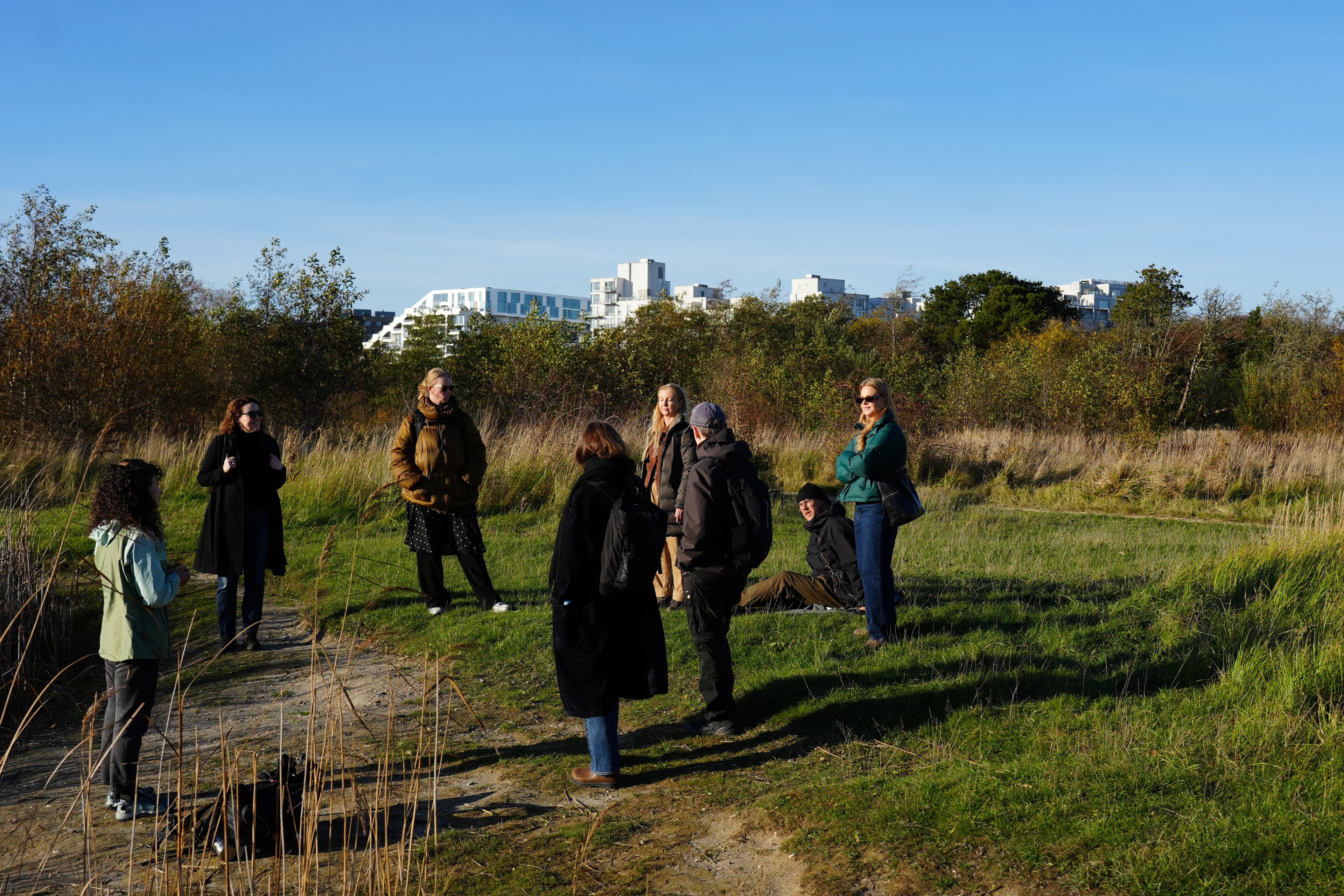
Before we move on, Dianna gives us a sense of the plan. We are not going far. We are not expected to achieve anything. We are just going for a short walk. A small loop around Kalvebod Common. We will walk without speaking. Senses open – mouths closed.
"Without experiences in nature, there are sensory elements and worlds we do not allow ourselves to experience. That is a shame, and I believe it makes us poorer as individuals."
We Overprepare for Nature
»Many people today approach nature with the idea that it demands something special from us,« Dianna says. She sees people feeling they need the right gear, the right knowledge, the right physical condition. As if nature is something you can only step into once you are properly prepared.
»We have forgotten how much a part of nature we ourselves are. And when we forget that, we start thinking we need to dress a certain way for it,« she says.
Dianna points out that urbanization has increased the distance between people and the nature they themselves are part of. And again and again, she finds that the barriers are rarely physical. They are mental. Fear of getting cold or wet. Fear of getting dirty. Of ticks. Of the unpredictable. Of not knowing what you will encounter.
The greater the distance between our daily lives and nature, the more the idea grows that nature is something extraordinary. Something big. Something you go out to.
But that idea gets in our way.
Because overpreparing does not just make the encounter more cumbersome – it makes it less likely that we will go at all. If everything has to be just right before we can step outside, we often end up staying in our climate-controlled living rooms and open-plan offices.
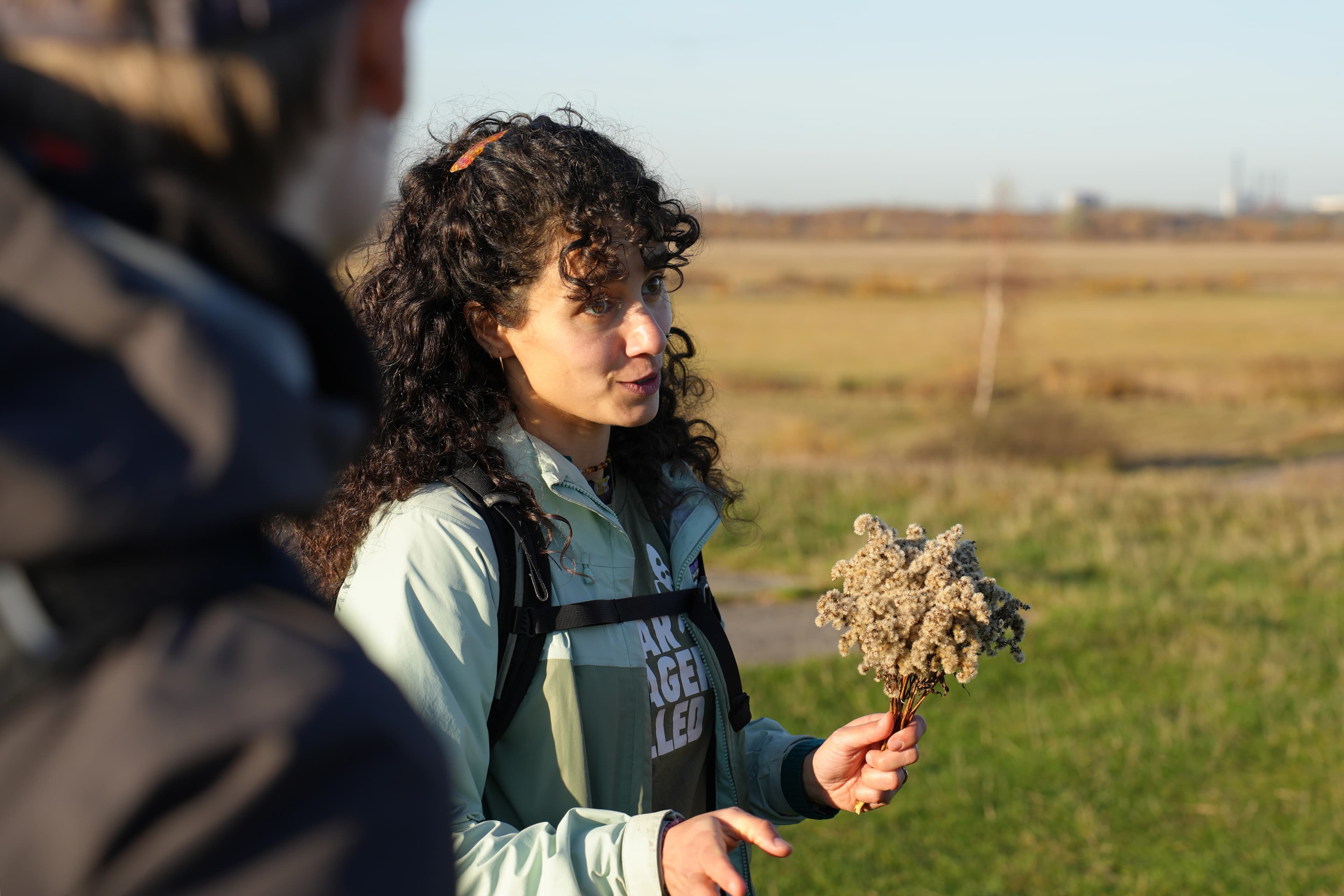
Dianna also believes that many people have lost touch with the most immediate forms of nature. The small openings in the city’s concrete. Plants growing between paving stones, in the cracks of the city. Greenery that is not staged. Nature that does not deliver a specific experience, but is simply there.
We Ourselves Are Nature
The gate to the common jerks slightly as it opens. We spread out, just as Dianna instructed. A few yards between each of us, a slow pace, no talking – just sensing. Listening, feeling, seeing.
At first, the silence feels artificial. Like a rule that has to be observed. But after a few steps, it begins to settle in differently.
The shadows are long and cool. We pass berry bushes and open stretches. The trees stand in rows – uniform and bare. Yellow leaves still hang in clusters from a few branches. A wire fence marks a boundary, and on a post beside it, a pictogram tells us that butterflies live here.
Nature moves between the accidental and the curated – between nature and center. The grass has been worn down into a narrow path, and our steps through the brush make the bare branches whip against us as we pass. A runner rushes by in a tight black outfit with water bottles strapped to the hips.
We walk slowly, each on our own, through twenty minutes of silence.
At a small pond, we gather again. Several people in the group say the same thing: that the slow pace felt unfamiliar. That the silence first made them self-conscious and then calmer. That does not surprise Dianna Khalidan. She points out that the human body is not built for a daily life in which so much sensory input is filtered away.
»We are simply not built for flat, uniform surfaces and steady temperatures. We are built to handle variation,« she says.
From her earlier work in psychiatry, she remembers how very simple actions could make a noticeable difference. Not necessarily exercise or long walks, but small sensory encounters with one’s surroundings. Standing barefoot in the grass, for example. Something many people did naturally as children, but which quickly disappears in adulthood between shoes and practical concerns.
»It is actually incredibly simple – and the body responds immediately,« she says.
The point is not that nature has to be used correctly or lead to a specific realization. Rather, the body already knows much of what we have learned to regard as inconvenient. Cold, uneven ground, dampness, wind, shifting surfaces. All the things that controlled daily life tries to keep out, but that also remind us that we are not standing outside nature looking in.
»Without experiences in nature, there are sensory elements and worlds we do not allow ourselves to experience. That is a shame, and I believe it makes us poorer as individuals,« says Dianna Khalidan.
Nature and Architecture Could Be Thought Together More Closely
After our stop by the pond, we move on. A cluster of conifers rises at the edge of the common, and beyond them the city begins to press in.
In front of us, a black bike path runs like a sharp line through the landscape. The asphalt is smooth and straight, drawn with a ruler. On one side are apartment buildings, glass facades, and repeating balconies. On the other side are trees, grass, and wind.
The contrast is almost demonstrative. Movement through the city is planned, efficient, and directional. On the common, the ground is uneven, the pace is slower, and attention is less controlled.
For Dianna Khalidan, the difference is not just a matter of aesthetics, but of behavior. The spaces we move through shape the way we use our bodies – and our senses.
»We build efficient cities that are optimized for getting quickly from A to B. But we lose all the little pauses and irregularities along the way,« she says.
She is not necessarily calling for more large parks separated from the rest of the city, but for a different way of thinking nature into everyday spaces. Not just as something you look at, but as something you move through and feel.
Paths do not always need to be straight. Transitions can be allowed to change character. Plantings can do more than mark boundaries or decorate, if they are allowed to shape spaces and create friction in an otherwise streamlined urban landscape.
»If people are truly going to benefit from the sparse nature we have, it has to be something they can feel, not just see,« she says.
Dianna believes that a lot of construction ends up with green elements that are easy to overlook. Pretty, but passive. Something you walk past, not into. Something conceived as decoration rather than as part of an ecosystem.
»If I could make one rule for new construction, it would be that one quarter of it had to be living nature,« she says.
Nature Is in the City Too, If You Look for It
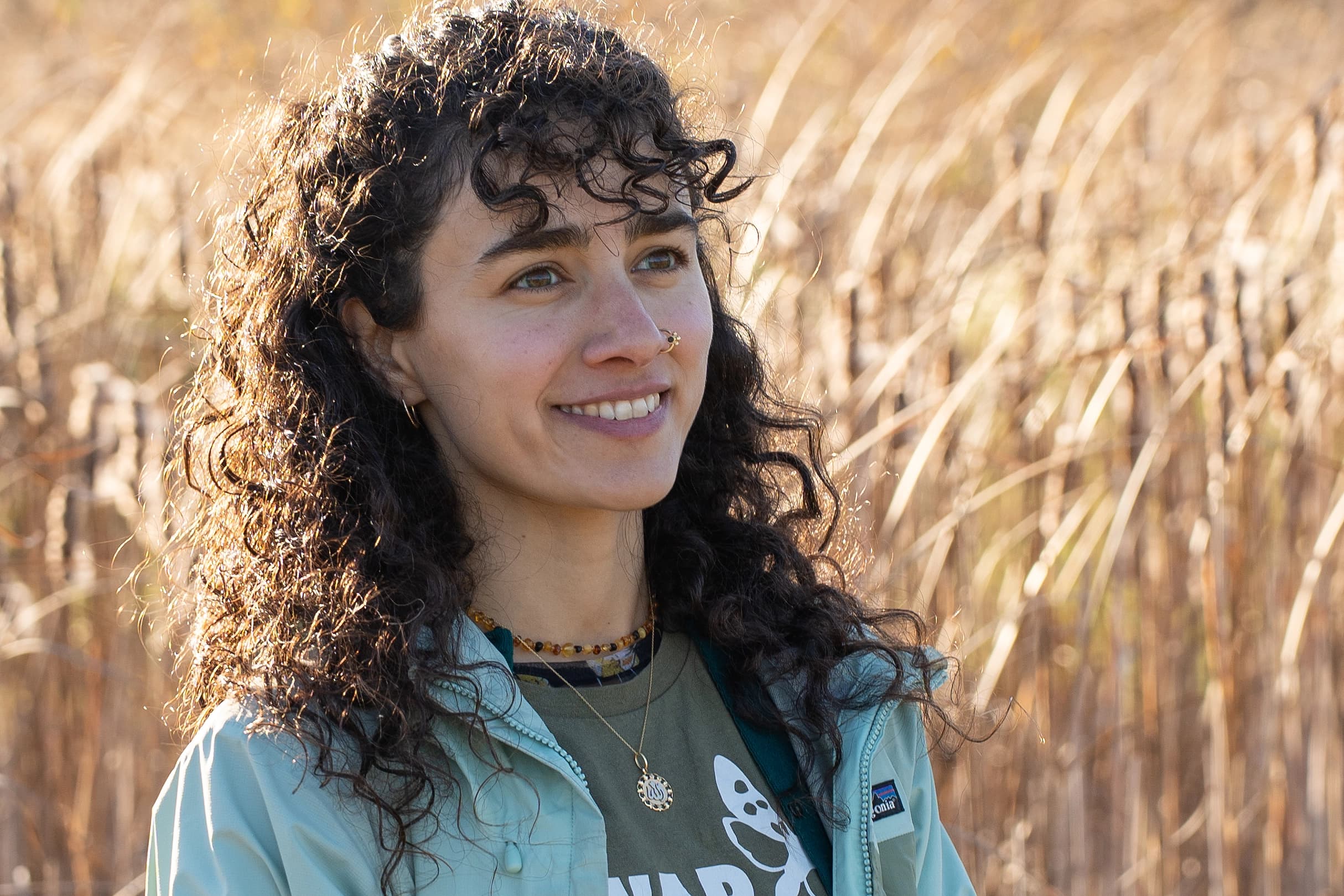
A little farther on, Dianna stops at a small patch of nettles.
»We are afraid of this plant,« she says, plucking a nettle leaf.
»And we pass that fear on to our children,« she adds.
The nettle is an example of the distance many people now have from nearby nature. Something you learn to avoid before you learn to know it. Something that becomes an irritation or a weed long before it becomes knowledge.
Dianna uses it to point out how much has slipped out of everyday life: familiarity with the plants and species that exist right around us, even where the city looks most planned.
We are allowed to taste it. There is a brief hesitation in the group, as if it still feels slightly risky. But the taste is mild, green, and fresh. What a moment ago looked like something best kept at a distance changes character the instant it becomes concrete.
When you know what you are dealing with, Dianna Khalidan explains, the relationship changes. What was once just background or a nuisance gains function and meaning.
»For many people, nature only gains real value once they understand how it can be used. I can feel ambivalent about that in relation to my work as a nature guide, because I do think nature has value in and of itself. But usefulness can be a good first step for many people,« she says.
She calls it nature blindness. Not because we cannot see nature, but because we can no longer read it. We register green as background, not as content.
»It also requires an effort from us. Find nature in the small things. We have to allow ourselves to see the value in small-scale nature, which truly is everywhere,« she says.
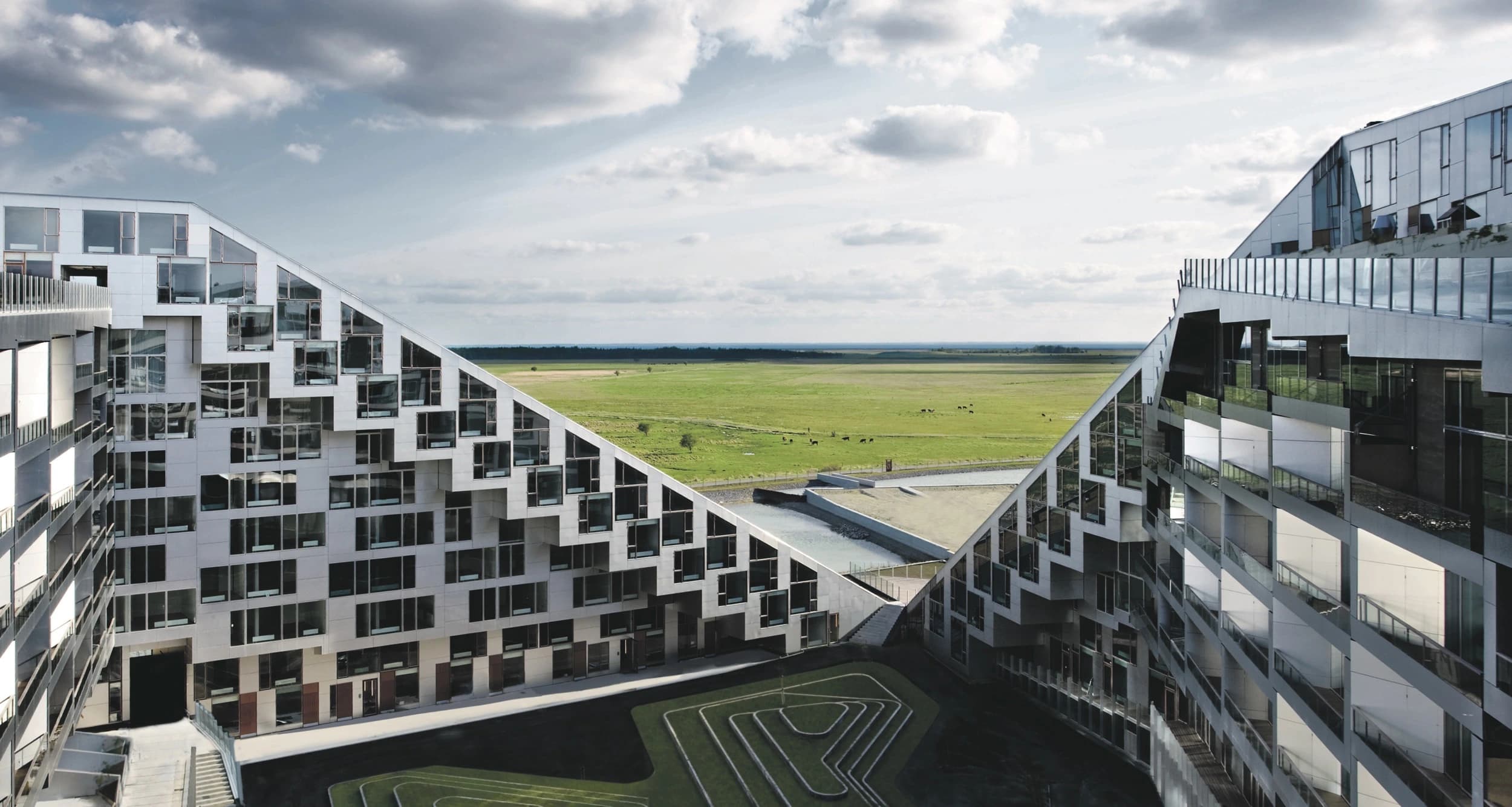
8 House looms in front of us. Bjarke Ingels’ iconic residential block, sitting like Ørestad’s final frontier. We are standing in the middle of an installation of wooden posts rising from the ground like the ribs of a ship stranded in the landscape. The shape makes sense here, Dianna explains. Because we are standing on old seabed. A place that, just a few generations ago, lay underwater.
The nature here is not untouched. It has come into being through an interplay of intervention, time, growth, and adaptation. In that sense, our architecture is exactly the same. It is the result of human decisions.
Perspective, Silence, and Wholeness
Ahead of us, a small hill rises above the flat landscape. From here, you can see how the area unfolds: the open stretches, the darker bands of trees on the horizon, small lakes edged with reeds.
The area has largely been arranged by humans, and some people may feel it is hard to sense that they are in “wild” nature here. The paths are clearly marked. There are fire pits, shelters, and picnic houses. Nature has been made accessible.
According to Dianna, that is part of the balance between protection, preservation, and use. If nature were only something you could not or were not allowed to enter, most people would never experience it. And in a country like Denmark, with so little wild nature, it also requires a willingness on our part to compromise in order to see the value in what is there.
»Nature has no expectations of us. So we should meet it without expectations too, and accept the nature we get. It is not a performance with a dramatic arc, and you cannot book a meeting with an owl or a fox. The strongest experiences are often the ones you did not anticipate – and they arise when we have time to open our senses. We make too little room for precisely that kind of unplanned experience,« she says.
That may be exactly where the real shift of the walk lies. Not in some grand revelation, but in a changed attentiveness. In the silence, the slow pace, and the small differences in surface, light, and movement that otherwise disappear easily in a daily life designed for speed and function.
We leave the nature center by the same route we arrived. The common is still there, flat and open. Planes are still taking off from the airport.
But our attention has shifted slightly. We cannot disconnect ourselves from nature. It is not a place we have to arrive at – but something we are already moving through, if we allow ourselves to notice it.