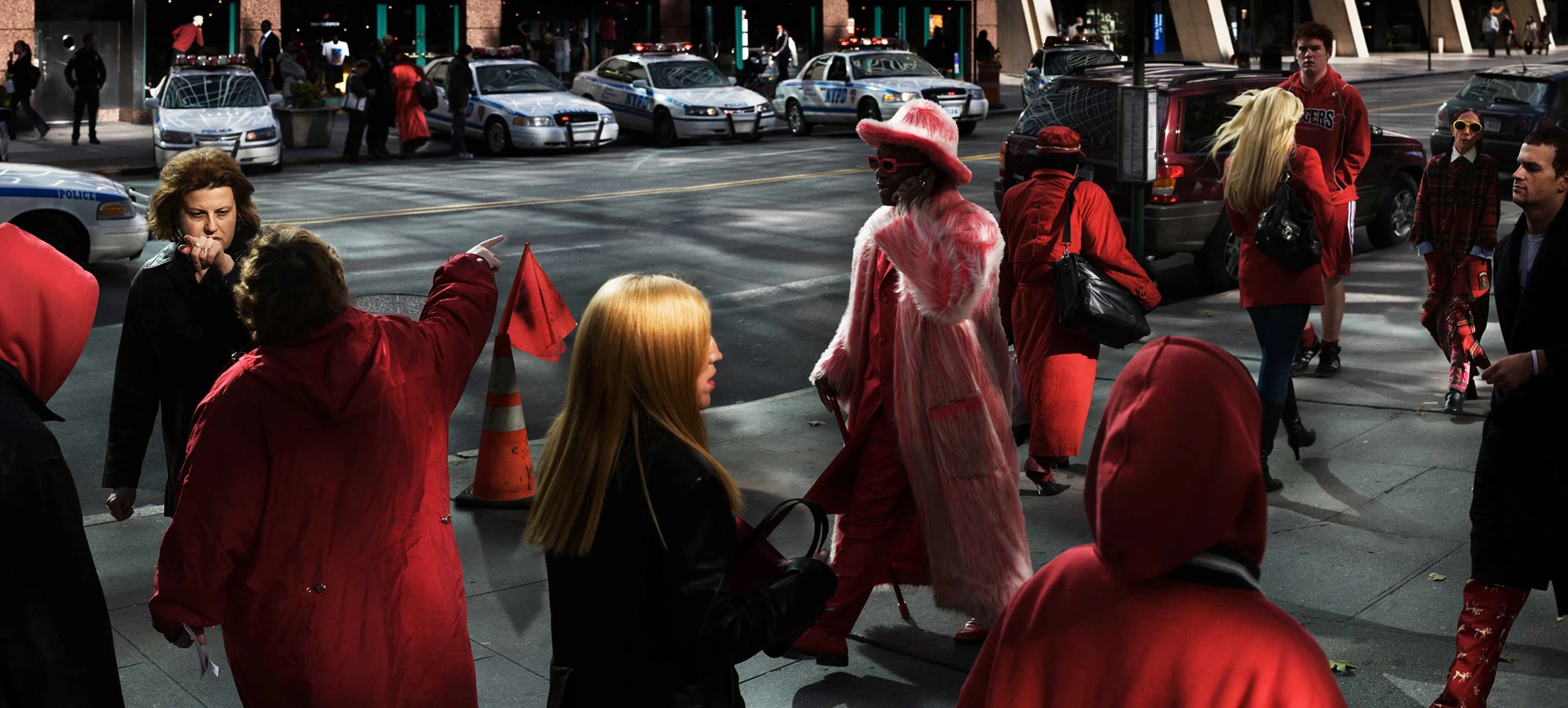
Video: The City Repeats Itself in Peter Funch’s Photographs of Life’s Hidden Patterns
Photographer Peter Funch has spent years exploring the patterns and micro-dramas of city life. In this short documentary, he reflects on the work behind his New York photo series – and on a photographic practice where time, repetition, and attention reveal what usually stays invisible in everyday urban life.
By Andreas Grubbe Kirkelund and Ida Kyvsgaard Bentzen
Step inside photographer Peter Funch’s studio in this documentary, where he invites us into his process and his way of seeing the world. Working with images made over long stretches of time – often from the same spot and the same framing – he challenges our assumptions about what a photograph is and how reality can be presented. The film offers a rare look at a practice in which patience, repetition, and attention matter just as much as the spontaneous glance traditionally associated with street photography.
Patterns in Everyday Life
In the film, we meet Peter Funch as he works on the project Tomorrow and Tomorrow and Tomorrow, which revisits his photo series 42nd and Vanderbilt and Babel Tales, created during his years in New York. At first glance, the images may resemble classic street photography: people caught mid-stride, moving through the city, absorbed in their own routines. But what appears fleeting and accidental is, in fact, the result of sustained, systematic work.
"I can’t conceptualize before I make the works. It always comes afterward. I don’t have a clear idea of it."
Funch photographs the same location again and again, then later gathers the material to find patterns you can’t see in the moment. He freezes time, concentrates it – or stretches it between two seemingly identical points. The method opens new narratives.
When people who were never in the same place at the same time suddenly appear side by side in a single image, connections and patterns emerge that would normally disappear in the speed of everyday life. Small gestures, repeated movements, and social rituals come into focus, revealing something fundamental about life in the big city – and about how we move through it.
The Idea is an Afterthought
Peter Funch doesn’t work from a fixed concept. On the contrary, structure and meaning arrive later in his creative process – when the photographs are viewed together.
»I can’t conceptualize before I make the works. It always comes afterward. I don’t have a clear idea of it,« he says in the film, underscoring that for him the photographs aren’t the product of a predetermined idea – rather the opposite. The idea takes shape through repetition, observation, and editing.
About Peter Funch
Peter Funch (b. 1974) is an award-winning Danish photographer with an international career matched by very few. He lived in New York for many years and now lives and works in Paris. Trained as a photojournalist at the Danish School of Media and Journalism in 1999, Peter Funch balances a traditional fine art career with more commercial campaigns.
New York as a Laboratory for Time and Place
New York City plays a defining role in his work – not as an iconic backdrop, but as a complex system of places, rhythms, and repetitions: a laboratory for observation, where architecture and urban spaces intersect with human behavior and are filtered through Peter Funch’s distinctive way of working with time.
These are also the three themes the documentary is built around: people, time, and place.
The result is a film for anyone interested in photography, street photography, and New York – but also for those curious about how images can be made slowly in a world that otherwise moves fast.
The film was produced in connection with the exhibition Tomorrow and Tomorrow and Tomorrow at the Danish Architecture Center.
Merer fra DAC Magazine
DAC Magazine
Barbara Marstrand on Life Behind the Door of the Teenage Bedroom
The City Through the Screen: Has the New Eye Level Become the Ground?
Why We Are So Fascinated by Symmetry: Interview with Per Mollerup

Nicolas Cosedis Has His Head in the Clouds – and That Gives Him a Unique Perspective on the Cities We’re Building