What the BLOX – A New Exhibition about a Building That Challenges Copenhagen
This exhibition tells the full story of how the Bryghus site was transformed into B From the outset, BLOX has both excited fans and provoked opponents.
It is a building that divides the city – but why is that? BLOX and explores how the building has shaped Copenhageners’ perceptions of the waterfront, the city and architecture in general. In connection with the opening, DAC is launching free admission for young people every Friday evening throughout 2026.
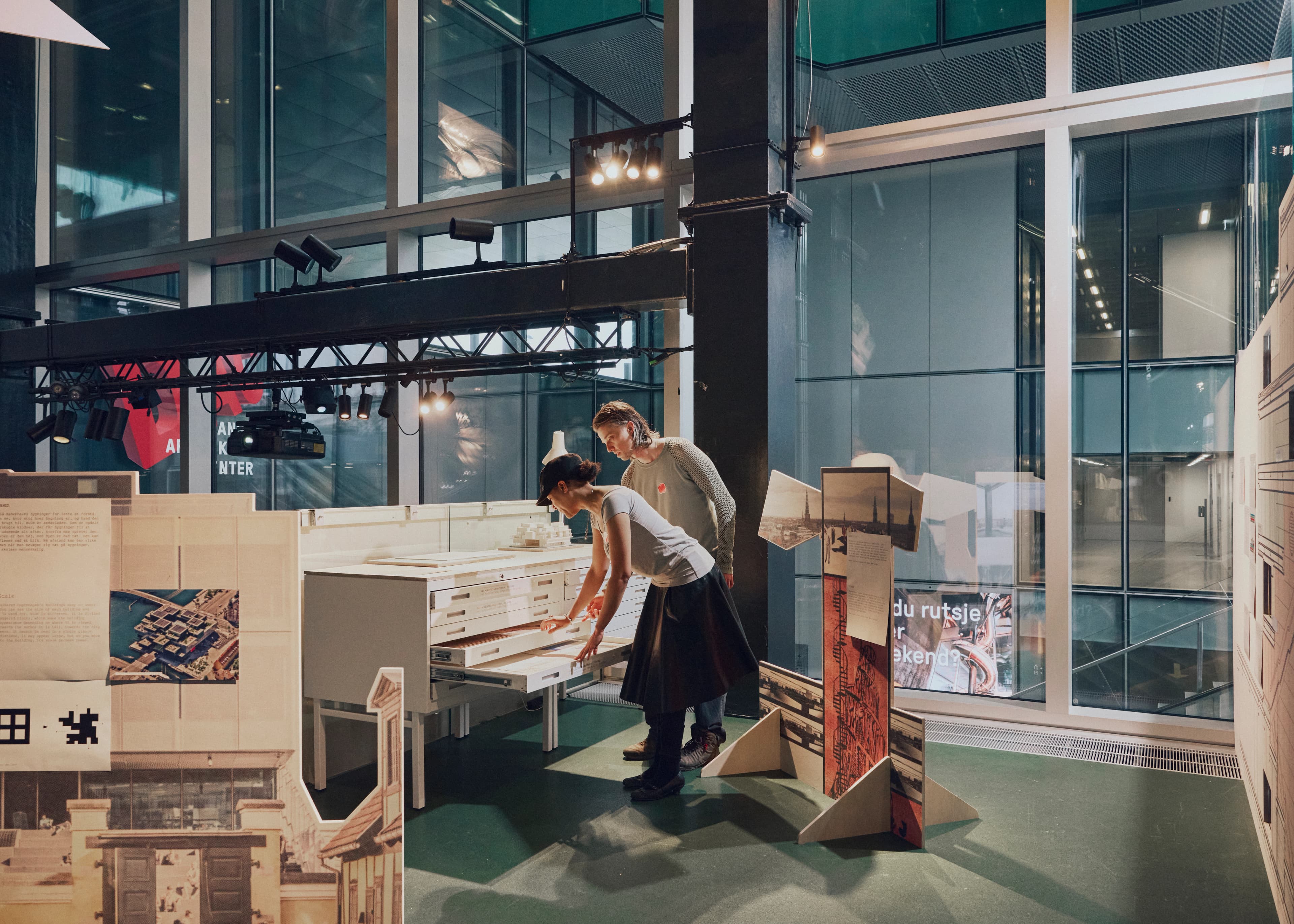
The exhibition is inspired by the human experience in and around BLOX: that feeling of losing sight of where you are, of what you’re seeing, and of the composition of the building itself.
It introduces guests to BLOX through spatial elements, archival material, and videos, revealing the structure, layout, and daily life of the building.
The exhibition touches on questions that have been asked about BLOX since it first opened: What’s hiding behind the facade? Why is it shaped like that? And what impact does it have on the city and the people who use it?
A City-in-a-City
BLOX is organized as a city-in-a-city with housing apartments, offices, fitness facilities, cafés, a playground and exhibition spaces. Like a city itself, it resists overview. There is no single place from which the entire building can be grasped, despite its transparency. Sightlines appear in fragments: towards the harbour, the traffic, and other people’s everyday lives.
BLOX was designed by the internationally renowned Dutch architects, OMA, who studied Copenhagen and found the city to be well-functioning and easy to decode, yet characterized by clear divisions and predictability. The architects designed BLOX as a challenge to this urban logic.
Functions are densely packed and overlapping without distinct hierarchies. Work, movement, leisure, and culture meet without fixed boundaries. Rather than an easily decoded overview, many impressions arise at once. The building is unapologetic and commands attention.
A Site Full of Resistance
BLOX was built on a site where the historical layers aren’t hidden but rather clash with one another. Under and around the building are traces of commerce, defense, industry, traffic, and culture, from fisheries and overseas trade to gunpowder and weapons, shipyards and, later, a busy ring road and parking. This exhibition allows guests to move through the history of both BLOX and Bryghuspladsen square, from fortification and industrial port to the urban space we know today.
It shows how these layers aren’t just part of the background, but put up a resistance which the architecture must work with. The site has been called the most difficult location in Copenhagen – not least because of the ring road that intersects it – and it is this complexity that shapes the building’s design and function.
An Open Question
What the BLOX brings together criticism, reactions, and previously shelved project proposals, showing BLOX not as a neutral intervention in the city but as a building that influences everyday life for everyone who moves within and around it.
The exhibition demonstrates that architecture is shaped by those who use and react to it, not just by designers at the drafting table. Rather than providing answers, What the BLOX asks questions about what happens when the city doesn’t apologize.
“This exhibition doesn’t seek to explain BLOX once and for all. Instead, it asks the question: What happens when architecture doesn’t make it easy for us, but actually demands something of us?” says Kent Martinussen, CEO of Danish Architecture Center.
This exhibition was created by Danish Architecture Center with the support of the Realdania philanthropic association.
Thanks to OMA, Realdania By & Byg, CPH City & Port Development, Studio Atlant graphic design studio, and Arkitektens Forlag publishers.
Free Admission for Young People Every Friday Evening
As part of DAC’s ambition to strengthen its relationship with young audiences – who already make up 17 per cent of exhibition visitors – DAC is introducing free admission for young people under the age of 27 every Friday from 4:00–9:00 p.m., combined with special prices on beverages. The initiative launches on Friday, January 30, immediately following the opening of the exhibition.
---
Facts
Exhibition period: January 30, 2026–January 10, 2027
Exhibition opening:
Thursday, January 29, 2026, 5:00–9:00 p.m.
At the exhibition opening, three light installations will be illuminated around BLOX as part of Copenhagen Light Festival – at the wooden pier, in DAC Passage, and in the Bryghuspladsen square.
Podcast about the BLOX building:
To mark DAC’s 40th anniversary and the new exhibition, What the BLOX, Danish Architecture Center CEO, Kent Martinussen, invites listeners on a tour of BLOX. In conversation with the host, Michael Booth, he recounts the history of the building and the ideas that have shaped it. This episode will be released on January 29, 2026 as part of DAC’s international podcast series Let’s Talk Architecture.
Opening hours:
Daily 10:00 a.m.–6:00 p.m.
Monday, Thursday and Friday until 9:00 p.m.
Press:
Press photos: www.dac.dk/presse
More information: www.dac.dk/what-the-BLOX
Contact
Johanne Troelsgaard Toft, Senior Press Officer
+45 6142 1927 · jott@dac.dk
About Danish Architecture Center
Danish Architecture Center (DAC) is an international cultural attraction that creates exhibitions and events and promotes debate about architecture and design. DAC operates as a public-private partnership between the Danish government and Realdania, a self-endowed charitable entity.
His Royal Highness the King of Denmark serves as patron of Danish Architecture Center.
DAC will be celebrating its 40th anniversary in 2026.