A 20-meter long fir tree and a forest of scrap wood is due to move into DAC for 3daysofdesign
During 3daysofdesign, Danish Architecture Center (DAC) will be premiering the exhibition This is Not a Forest – a venue-specific installation created by the design practice Archival in collaboration with DAC and Dinesen Lab.
Through an architectural installation featuring sound, light and scent, the exhibition follows the journey of wood from raw resource to architecture, and questions how we value natural resources today.
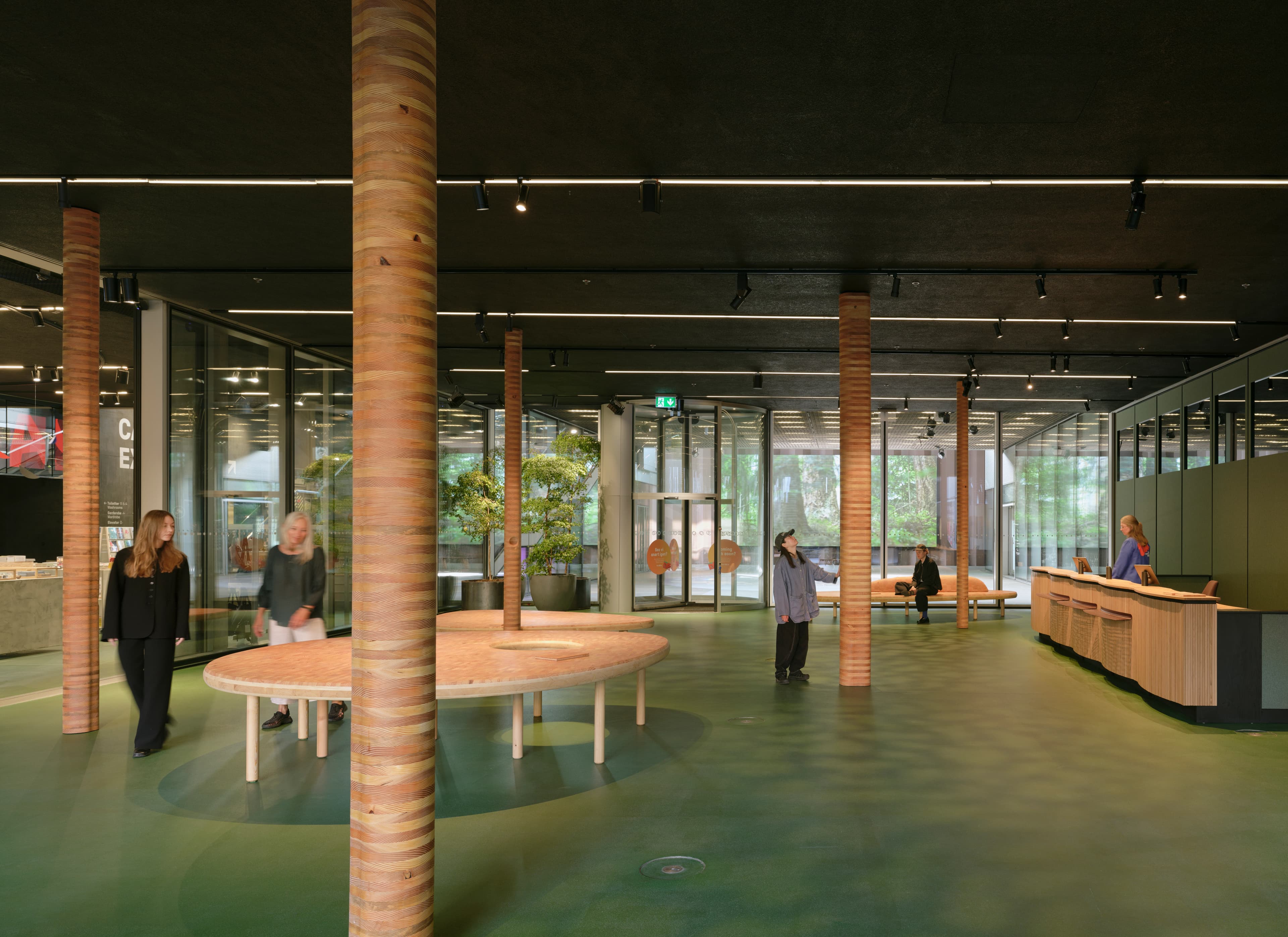
The felled Douglas Fir lying in front of DAC is no longer part of the forest. But it hasn't been transformed into design or architecture yet either. From Bryghuspladsen, the exhibition continues down through DAC, where wood planks are drying in front of the entrance, and an indoor “forest” of six 4-meter tall columns constructed out of scrap wood towers inside DAC.
The Wood That Normally Goes Unseen
Today, only a small proportion of cut lumber is turned into what we normally regard as the valuable finished wood. In much of the lumber and construction industry, the rest is rejected, down-graded, or incinerated as scrap wood.
This is Not a Forest explores what happens when off-cuts from production are given a new lease on life instead. In collaboration with Dinesen Lab, which focuses on use of the whole tree, off-cuts from production of Dinesen’s plank flooring have been turned into pillars and seating in DAC’s welcome area.
The four bespoke seats were designed by Archival and clad in Tiles from Dinesen, made of off-cuts from production. Here, the distal ends of the wood face outward, so the tree rings, structures, and irregularities stand out as intentional design features. The organic shapes and varying heights of the furniture invite different ways of engaging with, and interacting in, a space.
In this way, the exhibition signals a major shift in building design, where the focus is not only on which materials we use, but also on how we use them, and what we see as having value.
“With This is Not a Forest”, we’re aiming to challenge prevailing views of what has value, and demonstrate how what we usually overlook can be transformed into architecture and design. Equally, the exhibition points to a shift in our field, where it’s not just about choosing the right materials, but about using and repurposing them far more,” says Kent Martinussen, architect and CEO, Danish Architecture Center.
Wood As a Living Material
At the same time, the installation stages wood as a living material that continues to dry, crack, and change over time. The exhibition shows lumber that has not been kiln-dried, but air-dried, which is a slower process that reduces energy consumption, and makes it possible to use more of the tree trunk. Meanwhile, tiny fir tree shoots signal a very different time scale: In theory, they will not be transformed into floor boards until 2106.
“Wood is a living material that continues to dry, crack, and change over time. Instead of hiding its variations, we aim to make them visible and make them part of the architecture. Maybe biomaterials should be used for the same length of time it took them to grow,” says Emil Roman Frøge, architect and founder of Archival, which operates at the interface of architecture, artisanry, and materials research.”
Can a Forest be Smelled and Heard?
At the exhibition, the soundscape is inspired by the deep roots and tall tree canopies of the forest, while the light filters through the space like in a real forest. Meanwhile, a video brings the forests into DAC, connecting the installation with the locations where the trees were growing before they were harvested for design and architecture.
The scents in the exhibition were developed by Studio Pneuma in collaboration with Dinesen and Sissel Tolass, olfaction (smell sense) researcher. By analyzing airborne scent molecules, the atmosphere and memories of the forest are interpreted as sensory perceptions in the space.
In this way, the exhibition explores not only how we build with wood, but also how our senses detect and relate to it.
From Installation to Interior
DAC’s Welcome lobby has been transformed with bespoke seating, and a new reception desk made of wood repurposed from DAC’s previous units. The interior furnishings were designed and made by Archival in collaboration with MSSR Works as what are now permanent features of DAC. Space planning, analysis & design strategy by TOGETHER Architecture.
Green textiles from Kvadrat cover the walls behind the reception desk, while a green floor draws forest colors into the space, blurring the divide between installation, furnishings, and architecture.
When the exhibition closes in September, the wood columns will be dismantled and repurposed as stools at DAC.
In this way, the Welcome lobby will exemplify how scrap materials can be incorporated as permanent interior design and architecture.
Opening with Talk on Senses and Materials
On June 11, DAC will mark the opening of This is Not a Forest with an informal, free-admission, evening event from 5:00 to 9:00 p.m. The event will host opening speeches, cider and popcorn, and an AfterDAC talk.
In a panel discussion with DAC’s senior curator Pernille Stockmarr, representatives of Archival, Dinesen Lab, and Studio Pneuma will talk about the installation and their work with wood, scents, and sensory architecture.
Find Out More
About the program at DAC during 3daysfodesign
About the exhibition premiere
About the exhibition: https://dac.dk/en/exhibitions/this-is-not-a-forest
The exhibition will run from June 10 to September 27, 2026 at Danish Architecture Center.
Thanks
The installation was created by Archival in collaboration with DAC and Dinesen Lab, a part of Dinesen, makers of bespoke wood solutions.
Space planning, analysis & design strategy by TOGETHER Architecture.
Thanks also to Studio Atlant, Studio Pneuma, MSSR Works, Dinesen, and the sawmill Herskind Savværk.
Contact
Johanne Troelsgaard Toft, Senior Press Officer
+45 6142 1927 · jott@dac.dk
About 3daysofdesign
During this year’s 3daysofdesign in Copenhagen, Danish Architecture Center will be showcasing how designers and architects work with materials and human senses to create spatial experiences by design. On this year’s Make This Moment Matter theme, the festival is about presence of mind, and making intentional choices in design and materials. Find out more: https://www.3daysofdesign.dk/
About Archival
Archival is a design firm in Copenhagen, Denmark, founded in 2018 by architect Emil Roman Frøge. The multidisciplinary team at Archival operates at the interface between architecture, artisanry, and materials research. The firm develops projects by prototyping and 1:1 experiments with materials in their own workshop. Find out more: https://archivalstudies.net/
About Dinesen Lab
Founded in 1898, Dinesen is still the leading Danish producer of bespoke wood flooring and interior cladding solutions. The company’s appreciation of wood, and curiosity about its endless potential. inspired Dinesen Lab, a creative offshoot dedicated to exploring humankind’s connection with wood and the forest through bespoke design, art and architecture, and by promoting collaboration and projects that reinforce this bond. Read more at https://www.dinesen.com/da
About Studio Pneuma
Studio Pneuma was founded in 2019 by Diana Lindboe and Camila Boccardi Christensen. Both are qualified architects whose work translates spatial concepts into fragrances and design experiences. The mission is to raise our sensory awareness. Through their products, they create atmospheres that can be sensed spatially and bodily. Find out more: https://studiopneuma.com/
About Danish Architecture Center
Danish Architecture Center (DAC) is an international cultural attraction that creates exhibitions and events and promotes debate about architecture and design. DAC operates as a public-private partnership between the Danish government and Realdania, a self-endowed charitable entity.
His Royal Highness the King of Denmark serves as patron of Danish Architecture Center.
DAC will be celebrating its 40th anniversary in 2026.