When Water Becomes a Threat: How Do We Build in an Age of Climate Crisis?
One thing is certain: The water is coming. We need to rethink our cities and landscapes if they are to withstand heavy rainfall, storm surges, and rising sea levels. According to experts, it's time for us to take a step back and rebuild our relationship with nature.
By Kasper Foged

We still live in a world where living by the water is synonymous with luxury and exclusivity. The wealthiest people have waterfront homes, while those with less money have to settle for properties farther inland. When real estate agents talk about the three most important factors in determining a property's value, they always say the same thing: location, location, location. And a house with an ocean view remains one of the most desirable properties you can own.
But that's going to change dramatically.
These days, when you see a waterfront villa perched on the edge of the Øresund strait, it's increasingly difficult not to imagine the risks: serious flooding, expensive storm surge insurance – or, in the worst-case scenario, a home that can no longer be insured at all. And potentially even more alarming consequences.
Our Cities Aren't Built for Tomorrow's Climate
Sebastian Mernild is a professor of climate change and head of the SDU Climate Cluster at the University of Southern Denmark. He has spent years researching the changes we're facing in a future that's approaching all too quickly.
Our cities simply weren't designed to cope with the climate challenges that are certain to come.
»Cities around the world today are characterized by large amounts of masonry, asphalt, and dark surfaces that absorb heat during the day and release it at night. This makes heat waves extremely intense, with temperatures so high that several cities in Southern Europe are experiencing serious problems with dehydration among residents, increased mortality, and tourists avoiding these destinations during the summer,« he explains.
This means the structure of our cities needs to change.
We need more green spaces and bodies of water, along with white surfaces instead of black ones, so that solar energy is reflected rather than absorbed, helping to keep temperatures down. Paved areas and concrete surfaces should be transformed into green, shaded spaces that can also absorb rainfall.
»There's a concept called the Sponge City. The idea is that a city should function like a sponge, absorbing water and storing it for prolonged periods of drought, which will also become much more frequent. In general, the future will be an age of extremes, alternating between excessive heat, heavy rainfall, and severe drought. We're already seeing this in many places, including Eastern Europe, where an extremely hot summer has been followed by deadly floods,« says Mernild.

Rising Seas
Global sea levels have risen by around 20 centimeters since 1900. Over the next 75 years, they're expected to rise by as much as approximately one meter.
That said, there are many factors that scientists cannot predict, meaning the rise could happen even faster.
In other words, we're running out of time to protect our cities and everything we've built.
»Denmark has 8,800 kilometers of coastline. The question is whether we should build a wall or a dike all the way around the country. That's an enormous undertaking, and an extremely expensive one if the barrier has to be three meters high. But is that really the solution? Or should we be designing our cities differently, actually inviting water into the urban environment?«
Mernild believes we also need to confront some difficult questions about what we choose to protect.
»We have to discuss whether there are things we shouldn't protect. Are there places where we simply have to accept that the sea will come and swallow up the land? It could be a farmer's field, a forest, an area of vacation homes, or cultural heritage. What do we actually do with the Danish landscape? How do we deal with this blue zone, as we call it, where water can affect cities, new developments, metro systems, rural landscapes, and so on?« he explains.
Strategic Urban Leadership
Bjarne E. Jensen works at the Danish Architecture Center (DAC), where he teaches courses in strategic urban leadership.
He points out that planning and constructing new buildings in cities has become far more complex than it was just a few decades ago.
Many mayors have been elected on promises of stimulating urban development and regeneration. Yet new neighborhoods continue to spring up in areas exposed to climate risks.
Does it really make sense to invest billions in apartment developments along former industrial waterfronts when we already know these areas are vulnerable and could become extraordinarily expensive to protect in the future?
»When you construct a new building, a school for example, there are far more factors to consider than there used to be. Of course, there's the environmental aspect, including resources and building materials. But you also have to consider whether you're putting the building on a site where it could cost millions to protect it against flooding or rising groundwater,« Jensen explains.
»You also need to make sure the building can potentially be used for something else in the future if demographics change. It's a whole new way of planning cities.«


Different Approaches to the Same Challenge
Around the world, cities are working to protect themselves, adapt to a changing climate, or even consider moving farther inland.
In Hamburg, the city is protected by a flood barrier. But in the new HafenCity district, planners have taken a more creative approach.
Street levels have been raised, while historic buildings can be made watertight using heavy metal gates that slide into place in front of windows and entrances. Underground metal containers have also been installed that rise with the water to form a protective barrier, preventing floor-to-ceiling windows from being damaged.
In Venice, a system of movable flood barriers has been built to protect the city from storm surges.
A few years ago, the Danish architecture firm Bjarke Ingels Group (BIG) was involved in developing a proposal to protect New York from future flooding while integrating the coastal defenses into recreational public spaces.
And in the Danish town of Lemvig, a flood protection wall has been built around the town and incorporated into a new recreational harbor environment. In this way, the coastal defenses have created value for residents in more ways than one.
These are all approaches we're likely to see much more of in the years ahead.
The Changing Role of Landscape Architects
Rikke Juul Gram, a landscape architect and creative director at the architecture firm Schønherr, has also noticed a significant shift in her profession in recent years.
»In the past, we designed the public spaces around buildings. Today, for us, landscape architecture is much more about the development of society. It's about how we can help create the next generation of the welfare society – version 2.0,« she explains.
That means finding ways to incorporate renewable energy, infrastructure, climate adaptation, and biodiversity into the landscape.
And in that context, water plays a major role.
»If we're going to manage all the water coming from rising sea levels and storm surges, rainfall, and rising groundwater, we need to give more space back to nature. That way, nature can function as the sponge it has always been. Before industrialization, we actually lived quite comfortably with that natural system,« Gram explains.
She's referring to a time when we believed we could do whatever we wanted with the landscape.
We pumped water out of low-lying areas and drained wetlands so we could build on them instead. We assumed everything was under control.
But now, with far more water arriving than we ever imagined possible, it turns out we've created enormous problems for ourselves.
»We're facing a new reality where the way we've always done things no longer works. We need to reconnect with nature and rethink our understanding of what natural systems can actually do. Nature is capable of retaining water, provided we give it enough space,« she says.
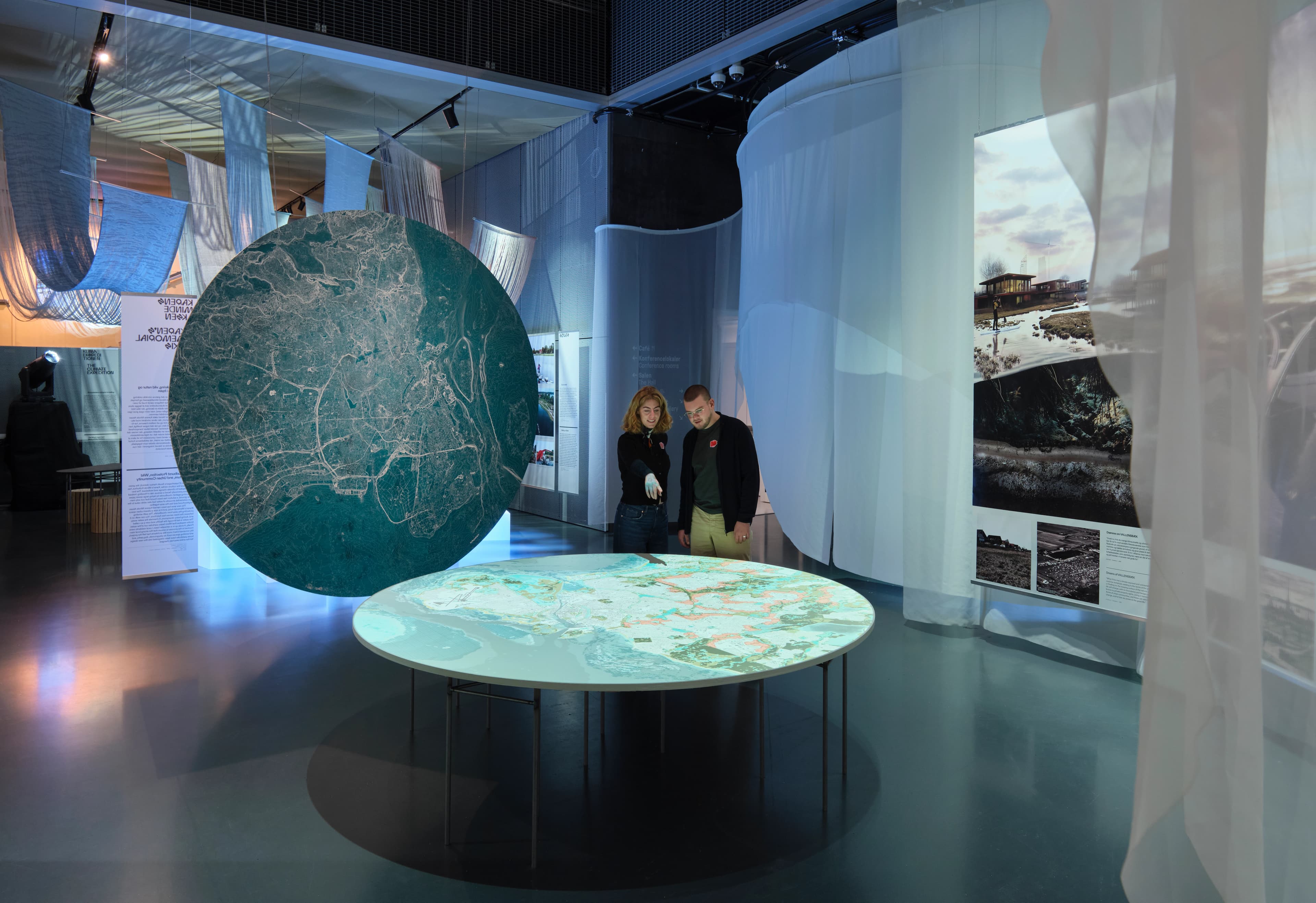
This is the central theme of Schønherr's contribution to the 2023 Venice Architecture Biennale – a project that can also be experienced as part of the exhibition Water Is Coming at the Danish Architecture Center.
»The project reimagines Copenhagen's Finger Plan from 1947. Our proposal is about rediscovering the city's relationship with the landscape. We want to reconnect with the places where water naturally flows, following the terrain shaped by the Ice Age,« Gram explains.
»We're proposing a way for water to flow through Copenhagen without disrupting the lives of its residents. Instead of continuing to expand the city onto artificial islands and reclaimed land, as we've done for many years – to the point where a third of Copenhagen is now built on reclaimed land – perhaps we should actually be thinking about developing the higher-lying suburbs. That's the kind of map we've created.«
A Future with More Nature and Homes on Stilts
At its heart, the project proposes an approach to urban development that works with the underlying landscape and natural systems rather than against them.
If implemented, it would create a radically different city in the future.
»South of Copenhagen and on the island of Amager, there would be houses either raised on stilts or relocated farther inland. We'd have wider coastal zones and broad stretches of landscape and wetlands winding in and out between the suburbs, creating recreational natural spaces alongside future urban development,« Gram explains.
But perhaps the most controversial element of the proposal is what it would mean for Lynetteholmen, Copenhagen's planned artificial island.
»Beyond the fact that we've created a plan that gives nature so much more space in Copenhagen, the most controversial part is that we're proposing to give Lynetteholmen back to nature. To turn it into a nature reserve. That's probably going to spark some debate,« Rikke Juul Gram concludes.