10 football stadiums where the architecture joins the game
A football stadium is among the largest and most expensive structures we build. It helps set the stage long before the opening whistle blows. We asked football expert Andreas Kraul to select ten arenas where the atmosphere isn’t just created – it’s built into the architecture.
By Bjørn Etone Broni Jensen
When people talk about the atmosphere at a football match, they often think of fans and chants. But a stadium can create an atmosphere of its own – through its architecture.
After all, stadiums are rarely alike. Some are woven tightly into the city, while others stand out with bold, distinctive designs. At their best, they become more than just venues for a game – they become part of the experience and a key element of the club’s and the areas’ identity.
Danish Radio football expert Andreas Kraul highlights a selection of arenas where the overall experience is shaped to a remarkable degree by the way they are designed and built.
About Andreas Kraul
Andreas Kraul is a journalist, football commentator, and expert for Danish Radio. Through his work, he has visited more football stadiums than most people ever will. His passion for the game and for unique experiences shines through in his book on 100 iconic football stadiums, where he takes readers on a journey to some of the world’s most outstanding arenas.
1. Estádio Municipal – Portugal
- Capacity: 30.154
- Opened: 2003
- Architect: Eduardo Souto de Moura
Like all roads lead to Rome, the paths descending from Monte do Castro lead to the home of S.C. Braga. Here, can you only see the match from the sidelines. At one end, a sheer rock wall rises above the stadium; at the other, the view opens out toward the city.
»The whole idea of playing toward – not a wall, but almost a mountain! It creates an incredible feeling when you're in the stadium,« explains Andreas Kraul.
Estádio Municipal was built for UEFA Euro 2004 and is carved directly into a former quarry. The stands are high and steep, and the sound reverberates between them and the rock wall instead of disappearing into the open air. The result is an atmosphere unlike that of almost any other stadium in the world.
2. Tottenham Hotspur Stadium – England
- Capacity: 62,850
- Opened: 2019
- Architect: Populous
When your stadium features a 65-meter bar, you’re never far from a drink – and that’s certainly the case at the home of Tottenham Hotspur.
The arena offers a glimpse of what the future of stadium design might look like.
»It can sound fantastic in there when everyone is singing, but there are also so many other things to do before the match,« says Andreas Kraul.
From the outside, the building has a bold, imposing presence, with glass facades and gray metal panels that can be illuminated in different colors. Inside, Europe’s longest stadium bar is part of the experience long before kickoff, turning the venue into a destination.
3. San Siro – Italy
- Capacity: 75,773
- Opened: 1926
- Architects: Ulisse Stacchini and Alberto Cugini
Two for the price of one. That’s what you get in Milan. San Siro is home to both AC Milan and Inter – two rivals who share the same stadium but fill it in different ways.
The experience begins long before kickoff, with panini and crowds gathering around the arena ahead of the match.
The building is instantly recognizable by its 11 cylindrical towers and distinctive red steel structures.
»The atmosphere can really build in there because it’s so large and imposing. It just reeks of Italian football and Serie A,« explains Andreas Kraul.
Inside, the stands rise steeply around the field, allowing the noise to quickly fill the entire stadium. San Siro is raw, intense, and rooted in Italian football culture.
4. Allianz Arena – Germany
- Capacity: 75,024
- Opened: 2005
- Architects: Herzog & de Meuron
A bright red inflatable raft? A classic Danish pop hit by Birthe Kjær? Or Bayern Munich’s home stadium on match day?
The facade consists of thousands of inflated panels that can be illuminated in different colors. Visible from afar, the arena stands as an icon on the outskirts of Munich.
»It’s not the stadium with the most intense atmosphere in the world. But if you want to build the best possible football stadium, Allianz Arena is the one you look to,« says Andreas Kraul.
As one of the first stadiums of its kind, it set the standard for modern stadium architecture. Every detail inside has been carefully considered – from crowd flow and accessibility to the view from the stands.
5. Maracanã – Brazil
- Capacity: 78,838
- Opened: 1950
- Architects: Waldir Ramos, Raphael Galvão, Miguel Feldman, Oscar Valdetaro, Pedro Paulo B. Bastos, Orlando Azevedo, and Antônio Dias Carneiro
Pelé, Ronaldinho, and Neymar. Brazil has produced some of the greatest football players in history – and a stadium to match. Today, Maracanã serves as the home venue for both Flamengo and Fluminense.
»When you're sitting inside the stadium and looking out at Rio, the mountains, and the Jesus statue, everything suddenly makes sense. It becomes a completely out of body experience to be there,« says Andreas Kraul.
Maracanã was built for the 1950 FIFA World Cup. At the time, it was the largest stadium in the world, with room for nearly 200,000 spectators – a surreal number even by today’s standards. It is vast and unpolished. Not built for perfection, but for togetherness.
6. De Kuip – Netherlands
- Capacity: 51,177
- Opened: 1937
- Architect: Leendert van der Vlugt
Some would call it a stadium. Feyenoord fans call it "The Tub". And that makes sense. With its oval shape and rugged steel exterior, De Kuip looks a bit like something you might keep in your sink at home.
»There’s nothing polished about it, nothing fancy. They can be that in Amsterdam. This is the dockworker’s stadium,« explains Andreas Kraul.
At Feyenoord’s home ground, the fans sit close to the field, and the tub-shaped design allows the noise to circulate from stand to stand. It wasn’t built to be beautiful – it was built to work and to create an atmosphere.
7. Stade Vélodrome – France
- Capacity: 67,000
- Opened: 1937
- Architect: Henri Ploquin
Bicycle races once circled the field here. Today, it’s the atmosphere that races around Olympique de Marseille’s home ground.
»The noise is insane, when the crowd really gets going in there. Marseille is a harbor city with a tough edge, but with a fantastic stadium,« says Andreas Kraul.
The arena’s signature feature is its sweeping, wave-like roof. Its shape evokes the sea and Marseille’s identity as a harbor city, while the stands sit close to the field. On match day, the atmosphere can reach the boiling point.
The stadium is deeply rooted in its surroundings. From the outside, it feels like part of the city; on the inside, it is designed to channel and amplify the energy of the fans.
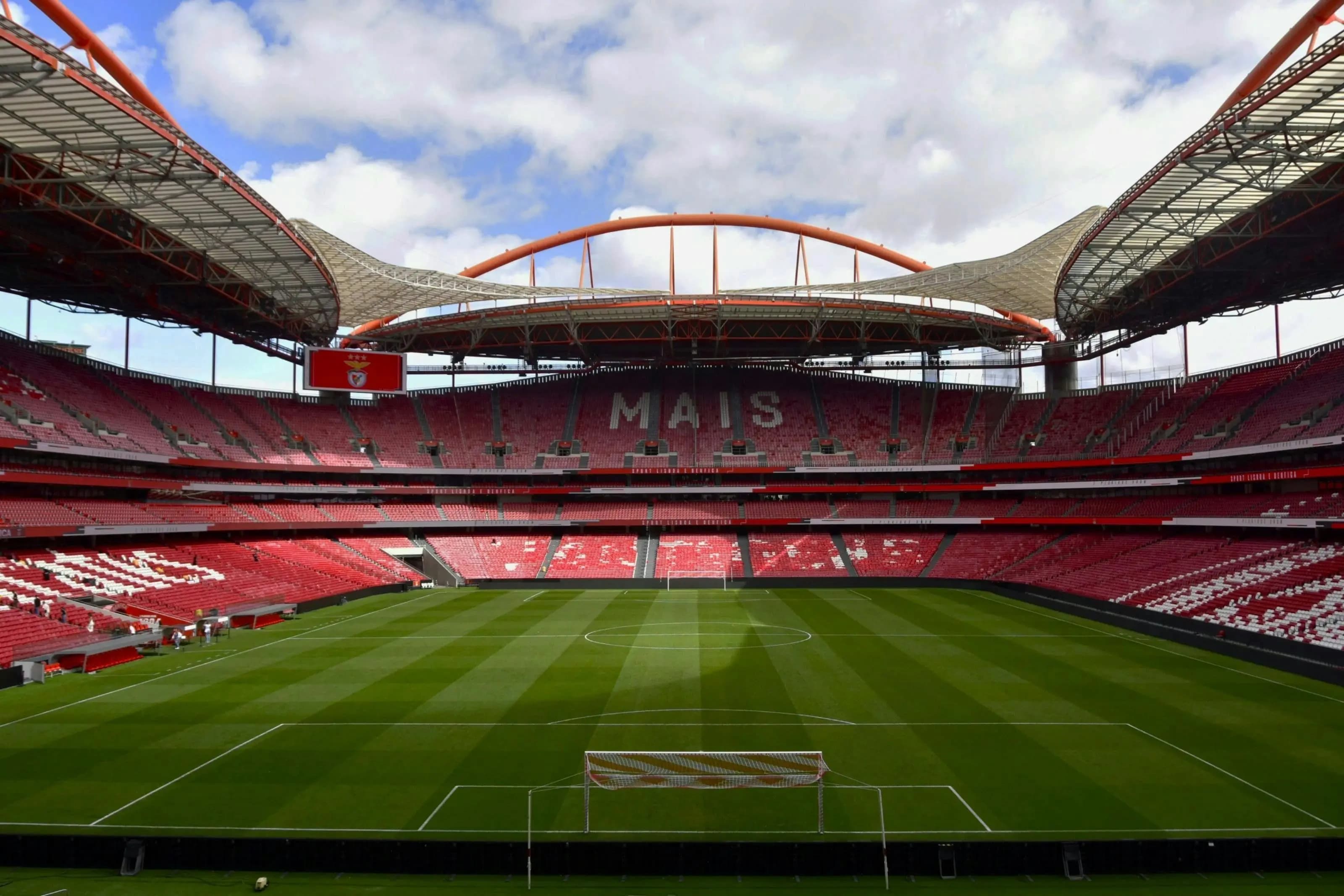
8. Estádio da Luz – Portugal
- Capacity: 65,200
- Opened: 2003
- Architect: Populous
»It’s difficult to make a soccer stadium beautiful. You can make it grand and impressive, but how do you make it beautiful? They’ve managed to do that here,« says Andreas Kraul.
Estádio da Luz is the home of SL Benfica. Its name translates directly as “Stadium of Light.” Natural daylight pours onto the field and into the stands, giving the space a light, almost floating quality.
The red structural elements tie the arena to the club’s identity, while an eagle flies over the field before each match. Here, the experience is not defined solely by noise and spectacle, but also by light, architecture, and tradition.
9. Anfield – England
- Capacity: 61,276
- Opened: 1884
- Architect: Archibald Leitch
In Liverpool, people are more likely to identify as Scousers than as British. Local identity is ingrained into everyday life – and nowhere is that more evident than at the home of Liverpool FC.
»There’s a saying in England called “The Power of Anfield.” It refers to a home ground where the atmosphere gives the team that little bit extra, so an evening match can really reach the boiling point,« explains Andreas Kraul.
Anfield has evolved over time alongside the city that surrounds it. Inside, fans sit close to the field, especially in the iconic The Kop stand. The “This Is Anfield” sign is part of the ritual as players make their way onto the field.
10. Olympiastadion – Germany
- Capacity: 73,856
- Opened: 1936
- Architect: Werner March
Usain Bolt broke his own 100-meter world record here, and Italy won its fourth FIFA World Cup title on this ground. Today, Olympiastadion serves as the home of Hertha Berlin.
»I certainly can’t walk into the stadium complex without feeling the magnitude of the place,« says Andreas Kraul.
The arena was built for the 1936 Olympic Games and still bears clear traces of that era. With its massive columns and stone structures, it evokes comparisons to Rome’s Colosseum. The site itself carries the weight of history, having witnessed both conflict and sport.
Here, it is not the atmosphere that leaves the strongest impression – it is the history.
Mere fra DAC Magazine